High Throughput Requirements
Operations moving 100+ pallets per shift require equipment designed for continuous duty cycles. Equipment must minimize downtime for charging or maintenance to maintain pick rates.
Warehousing operations require material handling equipment that efficiently moves pallets across large facilities, handles variable load weights from light packaging to heavy industrial goods, and maintains productivity across multiple shifts. Electric pallet jacks and stackers reduce operator fatigue while increasing throughput in high-volume distribution environments.
Shop NowMaterial handling pain points that warehousing operations encounter daily when moving inventory.
Operations moving 100+ pallets per shift require equipment designed for continuous duty cycles. Equipment must minimize downtime for charging or maintenance to maintain pick rates.
Warehouses handle loads ranging from 200 kg lightweight goods to 2,000+ kg heavy industrial materials. Equipment must provide capacity headroom for peak loads without sacrificing maneuverability.
Large distribution centers require moving pallets 100+ meters between receiving docks, storage racks, and shipping areas. Battery capacity and travel speed directly impact operational efficiency.
Multi-level racking systems require equipment capable of lifting pallets to heights of 2.5 to 4 meters safely. Mast stability and lift speed affect both safety and productivity.
Equipment selected for warehouse environments based on throughput requirements, load capacity, and facility layout.

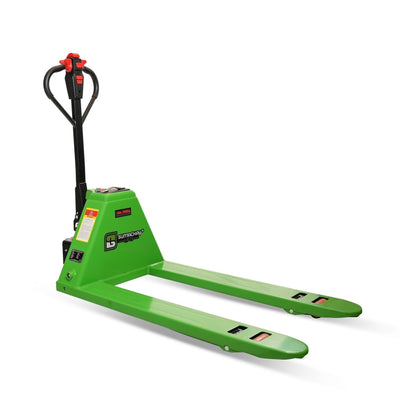
Workhorse for heavy pallets and long runs. The 2-ton capacity handles most warehouse loads while lithium-ion power supports continuous multi-shift operation without battery swaps.
View Product
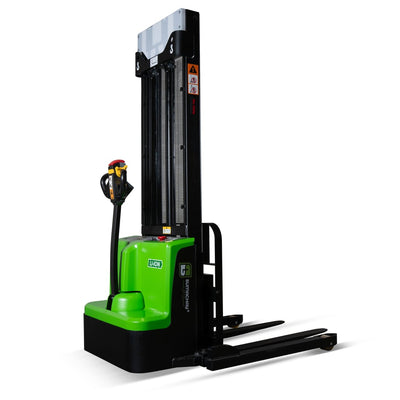
Designed for vertical storage in racked warehouses. 3.5-meter lift height covers standard industrial racking while maintaining stability under load.
View Product
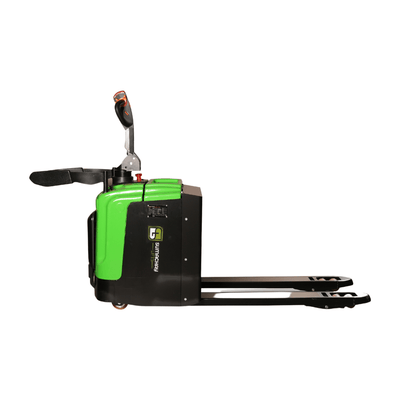
Ideal for large facilities with long travel distances. Ride-on platform and EPS steering reduce operator fatigue during extended shifts while 3-ton capacity handles heavy loads.
View ProductSelecting material handling equipment for warehouse environments requires evaluating operational requirements against equipment capabilities.
Operations moving fewer than 50 pallets daily may find manual pallet jacks cost-effective. Between 50 and 150 daily moves, entry-level electric pallet jacks reduce operator fatigue. Above 150 moves per day, invest in equipment designed for continuous duty with fast-charging lithium batteries.
Calculate your typical maximum load, then select equipment rated for at least 25% above that figure. This headroom extends equipment life and maintains performance when handling occasional heavy loads.
Measure narrowest aisles and turning spaces. Standard electric pallet jacks require approximately 2.4 meters for 180-degree turns. If racking heights exceed 2 meters, electric stackers become necessary for safe and efficient vertical storage.
Lead-acid batteries cost less initially but require dedicated charging rooms, ventilation, and regular maintenance. Lithium-ion batteries charge faster, last longer, require no maintenance, and allow opportunity charging during breaks.
Standard warehouse material handling equipment may not meet your requirements if:
Comprehensive guide covering load capacity, battery technology, and feature comparison for electric pallet jacks.
Use CaseSpecialized equipment recommendations for high-pick-rate fulfillment centers with narrow aisles.
CollectionBrowse the complete range of electric pallet jacks for warehousing applications.
All equipment ships from Canadian warehouses. Prices displayed in CAD. Free shipping available for orders within Ontario and Quebec.