

Space-Constrained Backrooms
Retail backrooms often occupy minimal square footage relative to sales floor. Storage racks, receiving areas, and staging zones compete for limited space, requiring compact equipment footprints.
Retail operations require compact, quiet material handling equipment that functions within space-constrained backrooms, navigates narrow aisles during restocking, and operates without disrupting customers. Equipment must balance maneuverability with sufficient capacity to handle receiving and inventory staging efficiently.
Shop NowMaterial handling constraints in space-limited backrooms with customer-presence considerations.
Retail backrooms often occupy minimal square footage relative to sales floor. Storage racks, receiving areas, and staging zones compete for limited space, requiring compact equipment footprints.
Restocking occurs during store hours in many retail formats. Equipment must operate quietly and safely in proximity to customers and retail staff without creating hazards.
Both backroom storage aisles and sales floor aisles in retail environments are narrower than warehouse standards. Equipment turning radius directly limits operational areas.
Retail material handling involves many short trips from receiving to backroom to sales floor. Equipment optimized for continuous long runs may be over-specified for retail patterns.
Compact, quiet equipment designed for narrow aisles, small backrooms, and sales floor operation.
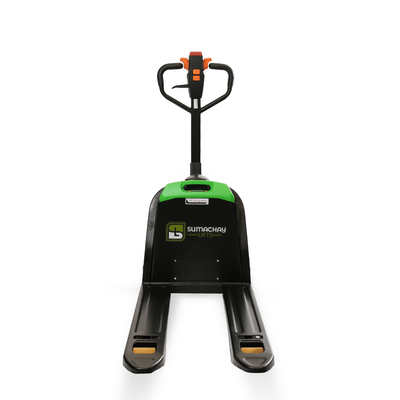
Narrow 21" x 47" fork dimensions fit through standard retail doorways and narrow backroom aisles. Compact design enables tight turning in constrained spaces.
View Product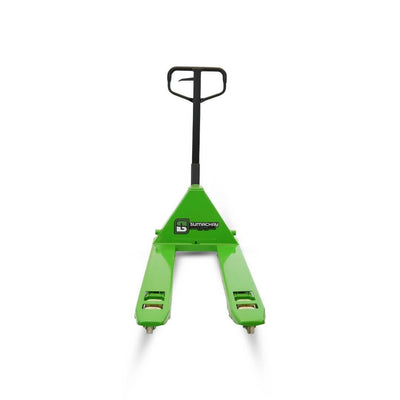
Manual narrow pallet jack provides economical backup for peak receiving periods. Lightweight design allows easy repositioning and storage when not in use.
View Product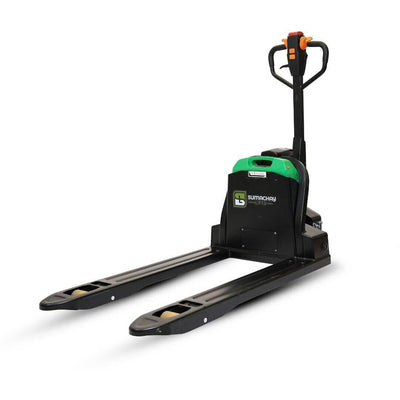
Quiet lithium-ion powered operation for sales floor restocking during store hours. 3,300 lb capacity handles standard retail pallets while maintaining compact dimensions.
View ProductRetail equipment selection prioritizes maneuverability and noise levels over maximum capacity.
Measure narrowest points in receiving areas, storage aisles, and doorways between backroom and sales floor. Pallet jacks requiring less than 2 meters turning radius fit most retail environments.
Electric equipment operates significantly quieter than propane or gas alternatives. Lithium-ion batteries eliminate the whine associated with some older electric models during charging.
Stores receiving 5-10 pallets daily can use manual equipment supplemented by electric for heavy items. Higher receiving volumes justify dedicated electric equipment for operator efficiency and injury prevention.
If equipment must access sales floor aisles, measure between fixture displays at narrowest points. Consider floor surface transitions between backroom concrete and sales floor tile or carpet.
Retail chains benefit from standardizing equipment across locations. Consistent specifications simplify training, spare parts inventory, and equipment reallocation between stores.
Compact retail equipment may not meet operational requirements if:
Independent buyer guide evaluating electric pallet jack models for Canadian operations.
Use CaseMaterial handling solutions for delivery vehicles and last-mile operations.
CollectionBrowse the complete range of manual and electric pallet jacks.
Equipment stocked in Canadian distribution centers for fast delivery to retail locations.
Browse compact and quiet material handling equipment designed for retail environments, or contact our specialists.